
Transcripts
Transcripts allow you to add text versions of your episodes. Transcripts will appear in embedded players as captions and on podcast websites and are linked in your feeds.
We use a third party vendor for transcription. The vendor uses AI technology to perform transcription. Transcription is an opt-in feature only.
If you use Pinecast to transcribe your episodes, we will use AI to transcribe the audio. AI can make mistakes, and you should already be reading and editing your transcripts.
Availability
Transcripts are only visible to your listeners if the "Make transcripts visible to listeners when available" setting is enabled. You can find this in your podcast settings under Transcripts.
Transcripts can be public for Starter and Icebox customers. Free (demo) plan customers' transcripts are only visible if the transcript was produced by Pinecast using credits you paid for: uploaded transcripts are not visible. We don't delete transcripts when your plan changes.
Transcription by Pinecast is available for episodes on shows that:
- Use a language supported by our transcription vendor
- Don't have an active feed redirect
- Don't have an owner on the icebox plan
Additionally, Pinecast may need to disable transcription for your show if you publish content owned by others (like reading books or news articles).
Please reach out if your transcription is not enabled for your show and you're unsure why.
Transcript enablement
By default, when creating a new episode, we'll select the radio button to transcribe your episode. This can be disabled by visiting Podcast Settings > Transcripts tab on your podcast dashboard and uncheck the option to enable transcription by default. This can be useful if you have your own transcripts and don't wish to use your transcription slots.
You can also change the visibility of transcripts. Uncheck the "Make transcripts visible to listeners when available" and save to prevent your transcripts from being shown to listeners. If you're transcribing your show for the first time and don't want to release the transcripts until they're all ready, this setting can help.
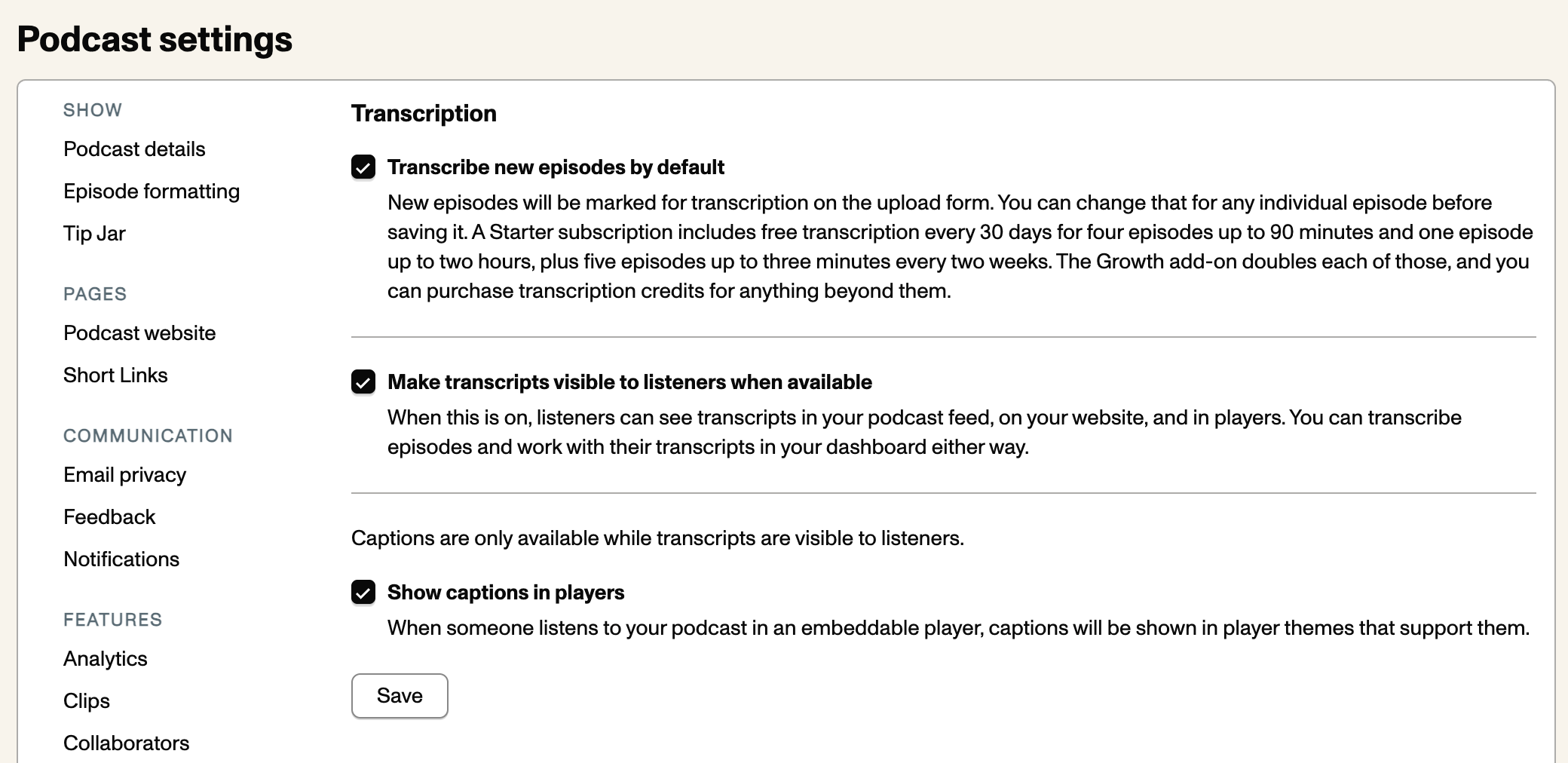
If transcript visibility isn't enabled, any existing transcripts will be invisible outside of your Pinecast dashboard.
Additionally, from this tab, you can enable captions in podcast players using the "Show captions in players" checkbox, which enables closed-caption style text as your episode plays. This is supported in the podcast, episode, and network players. It is only available when transcripts are visible to listeners.
How transcripts are exposed
Player captions
Players will show episode transcriptions as captions. As the episode plays, captions will appear on the player interface. This is available on both the podcast player and the individual episode players.

Not all episode player themes support captions. Specifically, the "Slim" theme is too small to show captions. Every theme has a Transcript link to read the transcript.
Podcast website transcripts
If you're using a preset theme with a Pinecast podcast website, a dropdown with the episode transcript will appear under the player for your episode. This section is only visible when transcripts are set to visible for the podcast and a transcript is available for the episode.

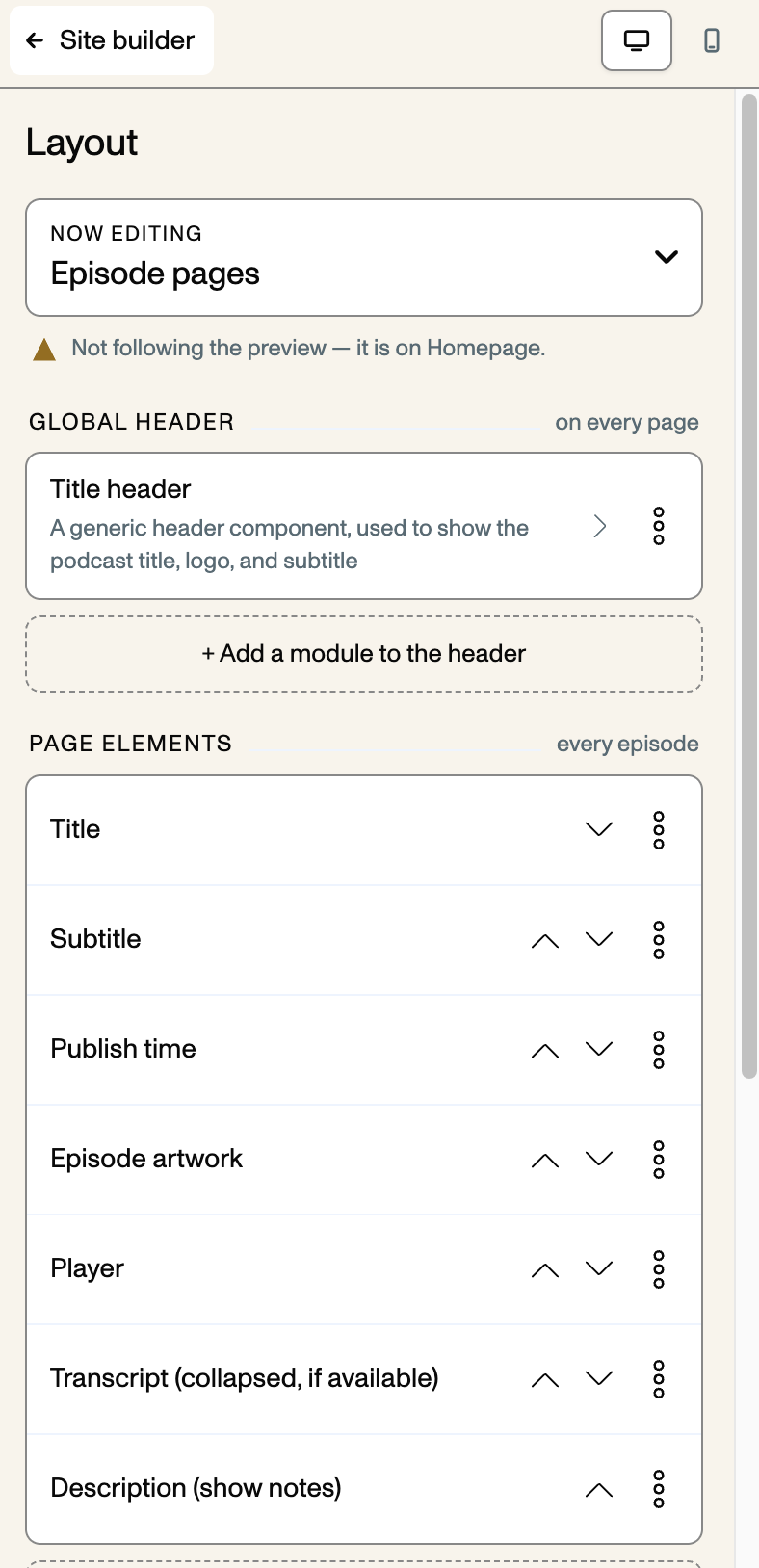
You can customize this in the Site Builder. In the Site builder, visit the Layout tab and choose to edit the layout of Episode Pages.
By default, the "Transcript (collapsed, if available)" module will be used to render transcripts. This collapses the transcript so it is hidden by default. You can reorder it among the page elements, or remove it by choosing the Delete option in the menu.
You can also click "Add an element" and choose the "Transcript (if available)" module. This will always show the transcript (without the option to collapse it) if the transcript is available.
Pricing
Each month (30 day rolling window), Starter customers receive:
- Five free transcriptions up to 90 minutes in length
- One additional free transcription up to 120 minutes in length
Additionally, every two weeks (14 day rolling window), Starter customers receive:
- Five free transcriptions of episodes up to 3 minutes in length
- Seven free transcriptions of clips up to 5 minutes in length
The Growth add-on doubles each of these four allowances.
Clip transcription is billed separately from episode transcription: transcribing a clip never draws on the episode allowances, and the clip's transcript is reused in every episode the clip is placed in.
Transcription beyond these limits consumes transcription credits, which can be purchased. Credits are deducted on the account that owns the podcast whose episode is being transcribed.
There is no cost to upload a transcript.
Buying transcription credits
One credit is equal to one minute of transcription. Transcription credits cost $0.03 each and are sold in units of 60 (one hour, or $1.80), with a minimum of five hours and maximum of 100 hours (300-6000 credits, $9-180). When you attempt to transcribe an episode that you do not have enough credits for, you'll be prompted to purchase more credits.
Billing for credits occurs immediately. Invoices and receipts can be found on the main account Settings > Payment tab of your dashboard along with the invoices for your paid subscription.
Transcribing episodes
Transcribing new episodes by default
If the "Transcribe new episodes by default" option is enabled on the Podcast Settings > Transcripts tab for a podcast, the transcription option is pre-selected for you on the new episode form. You can clear it for any individual episode before saving. Transcription starts once we've measured the episode's duration, since both eligibility and cost depend on how long the episode is.

If there are not enough credits available on your account to transcribe the episode, we skip it and send you an email with a link to the episode's Transcript tab, where you can purchase credits and start transcription yourself.
Alternatively, you can also upload a transcript that you produced yourself. This can be a VTT, SRT, or SBV file.
Manual transcription
You can visit any episode in your podcast dashboard and choose the Transcript tab.
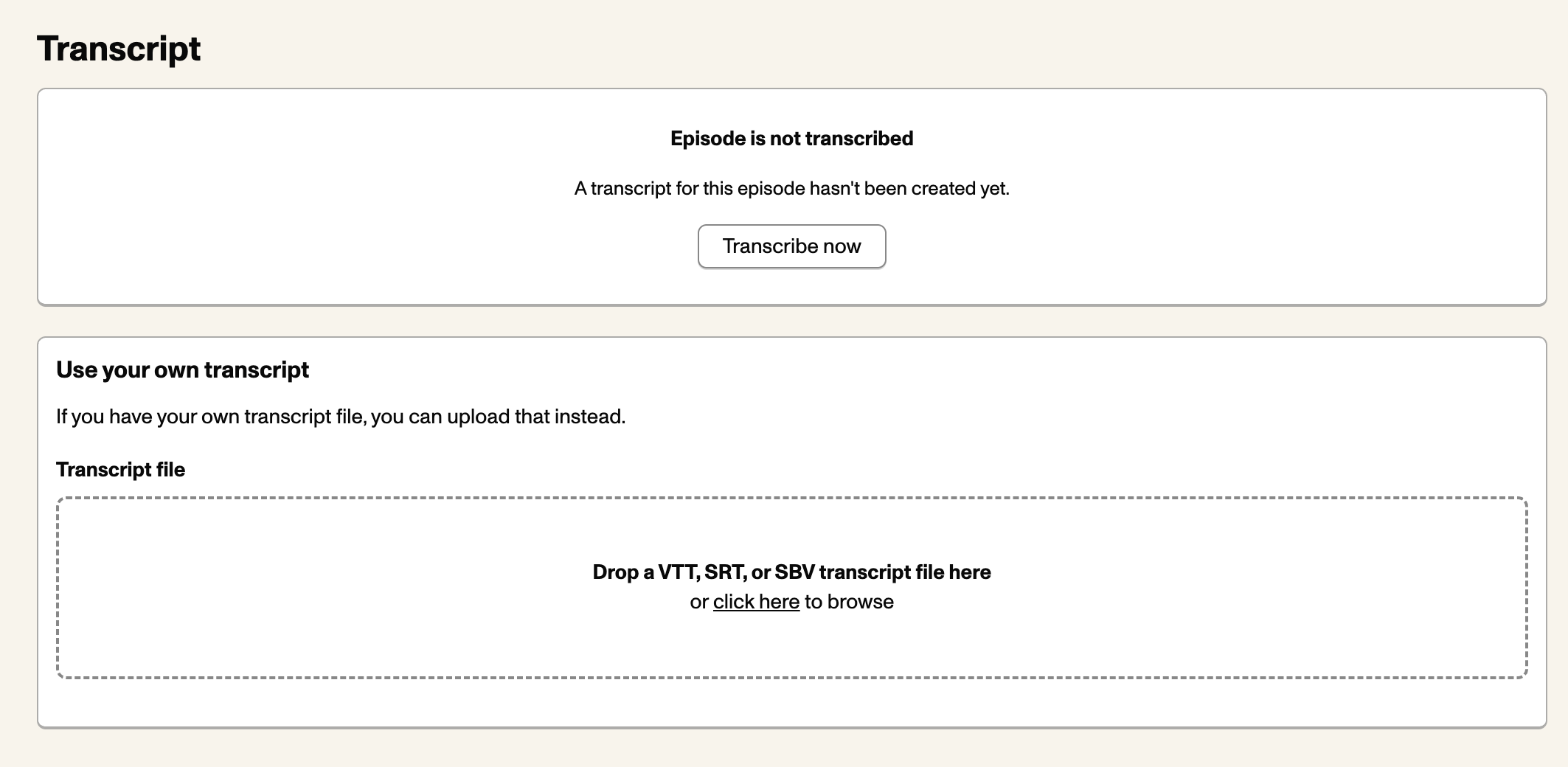
If the episode hasn't been transcribed, it'll offer to allow you to transcribe the episode. Clicking the Transcribe now button will open a modal to start the transcription process.
Alternatively, you can upload a VTT, SRT, or SBV transcript file. If you transcribe your episodes with another service or use a human transcription service, these files should be available to you. There is no cost to providing your own transcript files.
When providing your own transcripts, speaker labels are extracted automatically if the file uses VTT's standard <v Speaker Name> notation.
Kicking off transcription
If enough credits are available on the podcast owner's account, you'll be able to start transcription immediately.
Clicking "Transcribe" will reload the page to show a waiting message. It will automatically refresh with the transcript when transcription has completed.
Adding credits
If you do not have enough credits to transcribe an episode, you'll be able to purchase more transcription credits. Clicking the "Buy credits" button will purchase the credits immediately.

Retranscription
If new episode audio is provided, an existing transcription will be cleared from the episode. Editing episode audio will not automatically trigger transcription of the new audio. Instead, you will need to visit the Transcript tab to manually trigger the retranscription process.
Beware: if you change the audio for your podcast episode, your transcript will be cleared. If you paid credits for the transcript, they will not be refunded.
Pinecast ties a transcript to the audio file rather than the episode, since the contents of the audio may have changed.
Managing transcripts
On the Transcript tab of a transcribed episode, you'll have the option to download an episode transcript as raw text or as a VTT file. VTT files are formatted for captioning and include the time codes for each chunk of spoken text.
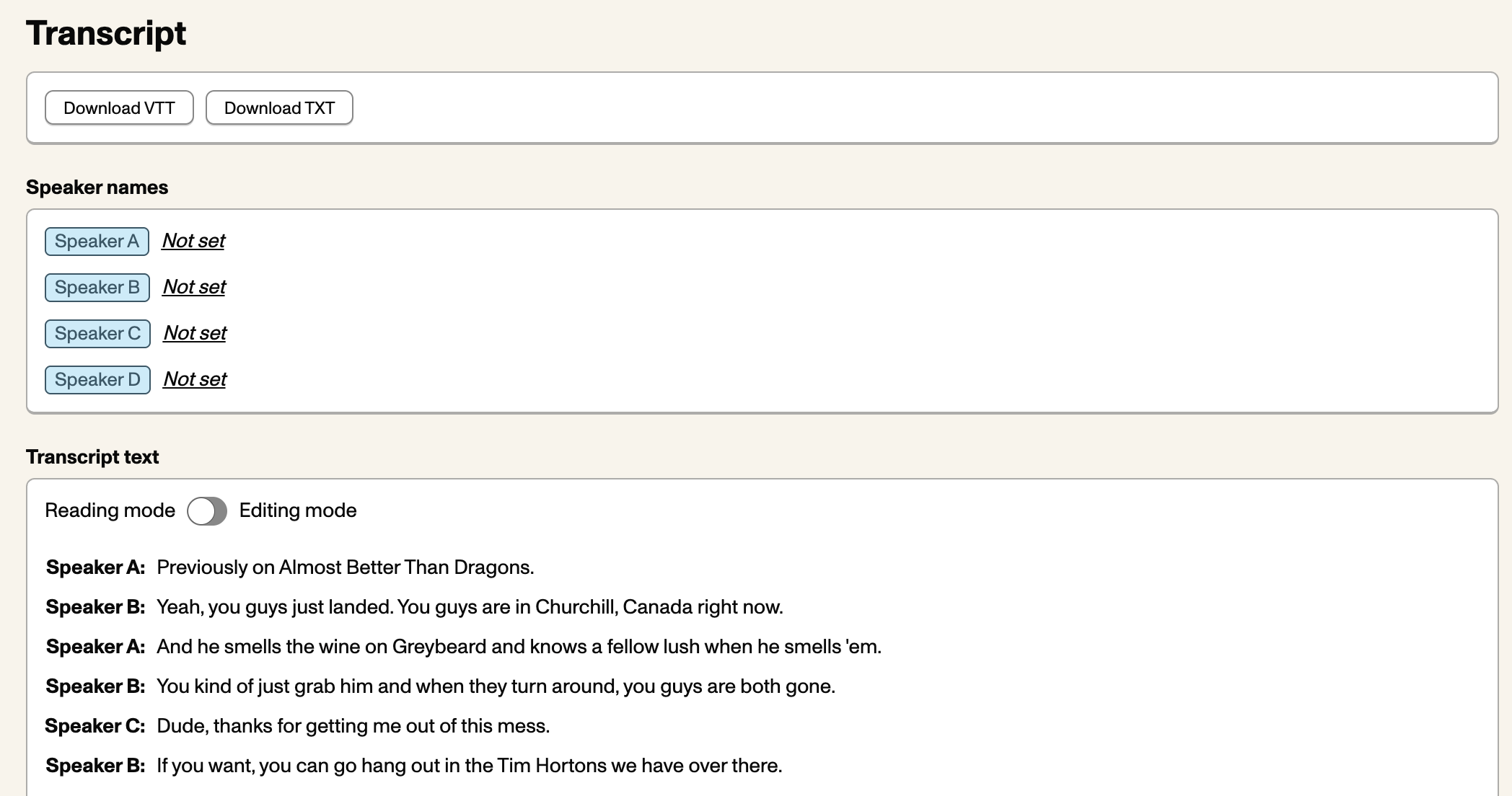
The same tab is also where you edit the transcript:
- Under Speaker names, give each detected speaker a name. We suggest names you've used before on your account. Speaker names appear on your podcast website and in the transcripts linked from your feed.
- Switch from Reading mode to Editing mode to correct the text of an utterance, change which speaker it belongs to, or merge and split utterances. Your edits are stored alongside the original transcription rather than replacing it.
- Delete transcript… removes the transcript from the episode. This is permanent.